Good morning, Agent.
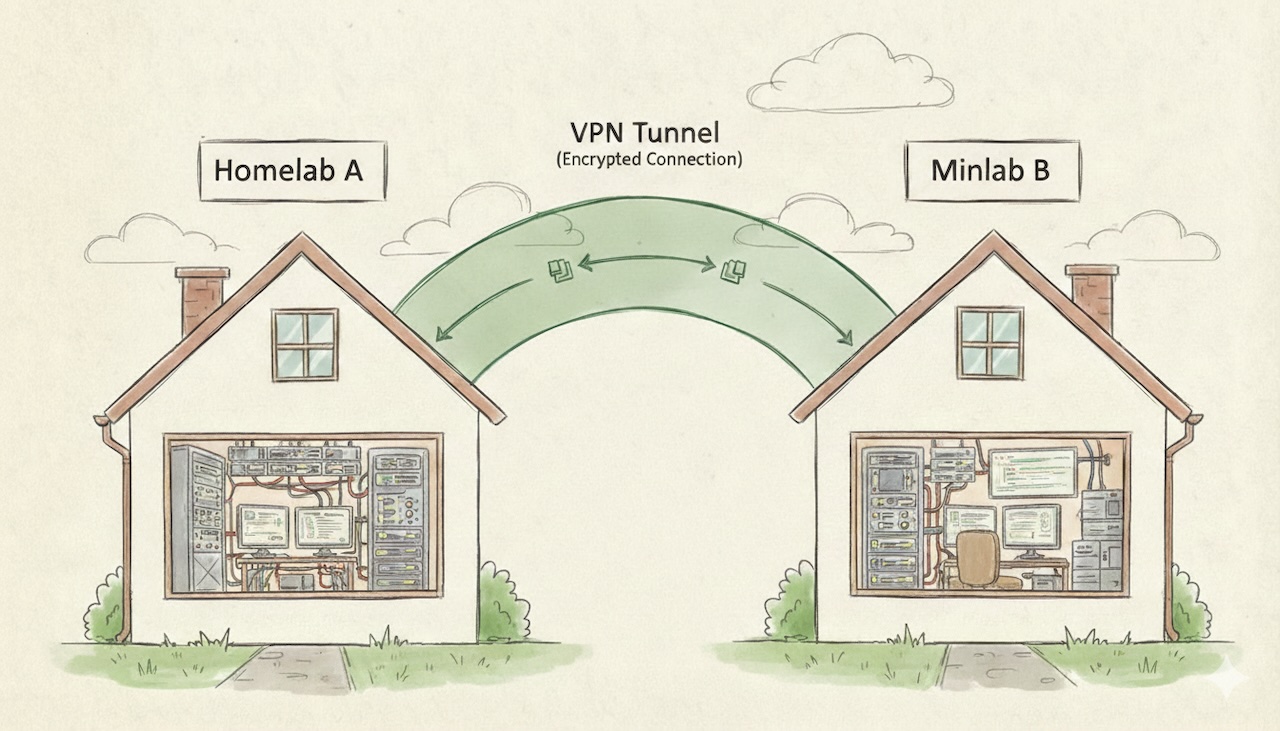
Your mission, should you choose to accept it, is to unify two disparate headquarters into a single, synchronized digital fortress. The target: a seamless “Home Lab” experience spanning two physical locations (House 1 (The Master) and House 2 (The Satellite)).
This isn’t just about blinking lights in a closet. This is about reclaiming control. It’s about establishing a secure, local extraction point for data, intelligence, and automation.
The Objective
The world is fragmented. You own two houses. The current reliance on public clouds is a tactical liability. We need a unified system that operates under the radar to manage:
- Tactical Climate Control: Precision temperature management for every room to slash operational costs. We need full control over the asset even when the team is off-site (the empty house).
- Energy Optimization: Intelligent power routing to leverage solar arrays. High-energy tasks (like the well pump) must execute only during peak production windows.
- Perimeter Access: Remote authorization capabilities to open gates for supply drops (packages).
- The Archive: A private, local cloud for sensitive photographic intelligence (Immich).
- Surveillance: AI-powered sentries monitoring the perimeter (Frigate).
- Entertainment: On-demand media streaming (Jellyfin) for downtime between missions.
The Arsenal (Hardware)
Standard issue laptops won’t cut it. You’ve been equipped with the Intel N97 Mini PC.
- Codename: NiPoGi (or similar Acemagic operatives).
- Specs: 4 Cores, 16GB RAM, 512GB NVMe.
- Why: It looks like a toy, but the N97 is a sleeper agent. Its GPU outperforms the N100 by 40%: critical for transcoding video streams and running on-device AI models without blowing your cover (or your budget).
- Cost: Sub-€180. Low profile, high impact.
The Strategy: Master & Satellite
We are deploying a split-cell architecture.
House 1 (Master Base): This is the brain. It holds the heavy data and runs the core logic. It houses the primary 2TB+ storage silo for “The Archive” and media libraries.
House 2 (Satellite Base): A lightweight outpost. It syncs critical data and maintains local environmental control, reporting back to the Master.
The Secure Tunnel: To link these locations without alerting local ISPs or dealing with messy port forwarding, we are utilizing Tailscale. It creates a mesh VPN, an invisible encrypted corridor that makes devices in House 2 believe they are sitting right next to the Master in House 1.
The Payload (Software Stack)
The operating environment is Proxmox VE. It allows us to compartmentalize assets. If the media server is compromised or crashes, the security system stays online.
1. The Overwatch: Home Assistant OS (VM)
The central nervous system. It executes complex logic to optimize resource consumption.
- Energy: It tracks solar production in real-time, automatically diverting excess energy to heavy machinery like the well pump.
- Access: It bridges the physical gap, allowing us to remotely unseal the gates for deliveries.
- Integration: It unifies assets like the Lefant robot vacuum (via HACS) and Alexa (via Nabu Casa).
2. The Archive: Immich (Docker)
We are severing ties with Google Photos. Immich provides facial recognition and semantic search (e.g., “show me the cat on the sofa”) running entirely on local hardware.
3. The Sentry: Frigate (Docker)
An NVR system that doesn’t just record; it sees. Using AI object detection (ideally boosted by a Google Coral USB accelerator), it filters noise and alerts you only when a threat, or a delivery driver, is confirmed.
4. The Failsafe: 3-2-1 Backup Protocol
No mission succeeds without contingencies. Intelligence is worthless if it can be wiped out by a single drive failure or ransomware strike. We are implementing the 3-2-1 Backup Rule:
- 3 Copies: The production data, plus two backups. If the primary silo is compromised, we have redundancy.
- 2 Media Types: One copy on the NVMe drives, another on external HDDs or network-attached storage. Different failure modes mean better survival rates.
- 1 Offsite: The third copy lives beyond the perimeter. In our case, House 2 serves as the offsite location for House 1 (and vice versa). With Tailscale linking them through an encrypted tunnel, each location becomes the disaster recovery site for the other. This ensures that even if House 1 burns down or floods, the mission-critical data survives at House 2. For added paranoia, encrypted cloud snapshots (Backblaze B2, Wasabi) can serve as a fourth copy.
The dual-house setup naturally supports this: House 1 holds the master archive, House 2 maintains a synchronized mirror via Tailscale. Add encrypted cloud snapshots, and you have a fortress that laughs at disk failures and natural disasters.
The Roadmap
- Acquisition: Secure the N97 unit.
- Deployment: Flash Proxmox. Establish the perimeter.
- Infiltration: Install Home Assistant and Tailscale. Verify the secure tunnel.
- Extraction: Migrate photo intelligence to Immich.
- Expansion: Replicate success at the Satellite base.
The clock is ticking. You have your orders.
This post will not self-destruct, because we have redundant backups.